What Your Premium Tax Credit Doesn’t Protect You From Anymore

Nobody sent out a warning label when the rules changed. If you’ve relied on the premium tax credit to make your health coverage affordable, the protections you signed up under a few years ago aren’t the ones you’re living under now.
Two of the biggest guardrails quietly disappeared heading into 2026. Most people won’t find out until they’re staring at a tax bill they didn’t see coming.
That’s the gap we spend our days closing. We shop every major carrier in all 50 states and build coverage around your actual income, not a generic subsidy estimate. If you want to know exactly where you stand before tax season explains it for you, set up a free consultation and we’ll walk through it together.
Key Takeaways
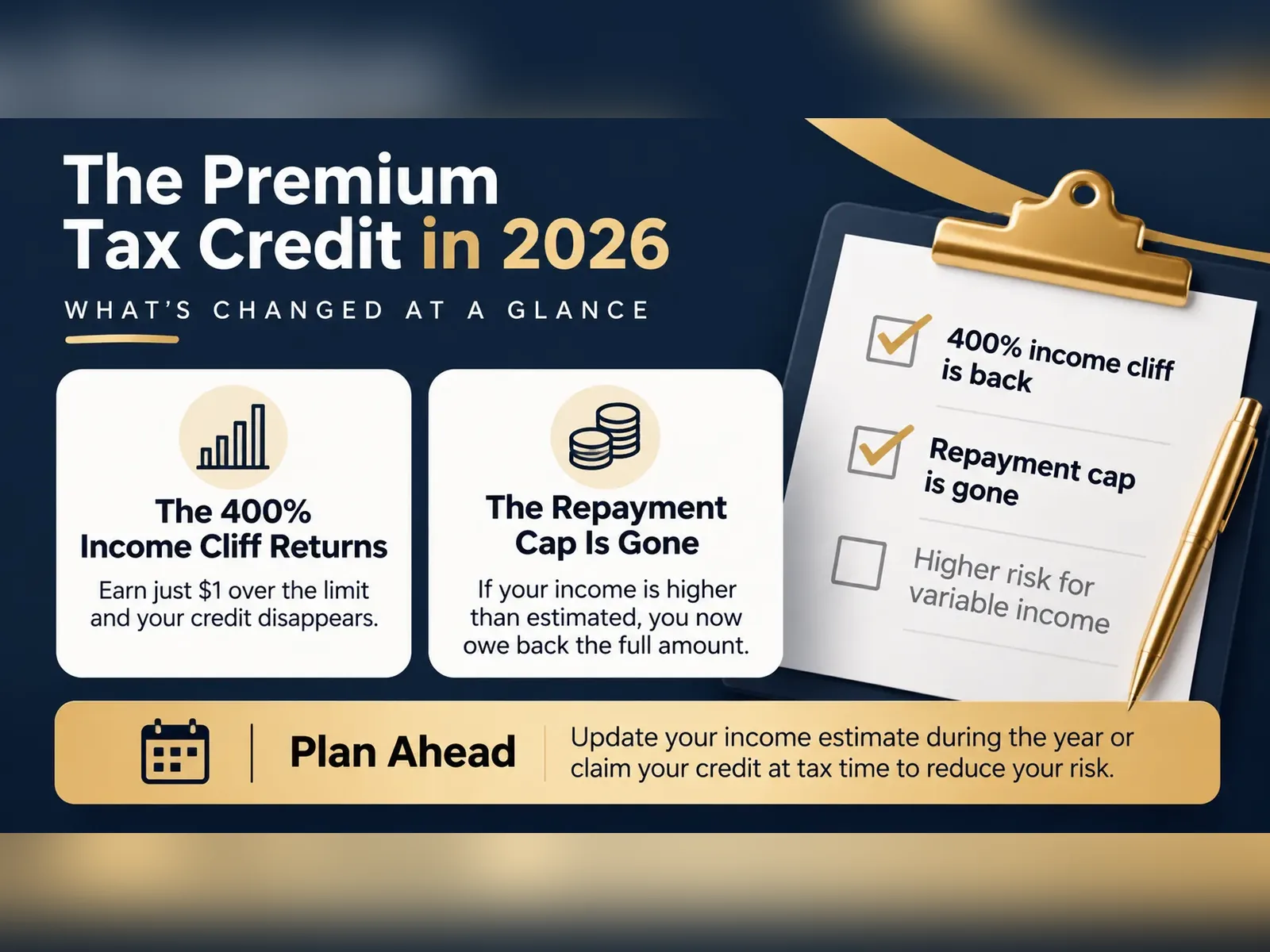
- The 400% income cliff is back for 2026. Earn one dollar over the line and your credit doesn’t shrink. It disappears.
- The cap on repaying excess advance credit is gone. If your income came in higher than estimated, you now owe back the full difference, with no ceiling.
- Self-employed earners, 1099 workers, and early retirees managing variable income carry the most exposure.
- Updating your Marketplace income estimate mid-year, or claiming your credit at filing instead of in advance, can limit the damage.
- Your actual coverage isn’t at risk here. This is about subsidy math, not losing your plan.
What Is the Premium Tax Credit?
The premium tax credit caps what you pay toward a benchmark Silver plan as a share of your income. The government covers the rest.
You can take it two ways. The advance premium tax credit (APTC) pays your insurer directly each month, lowering your bill right away. Or you can skip the advance entirely and claim the full amount when you file. Some people split it, taking part in advance and the rest later.
Either path runs through the same reconciliation step at tax time. Whatever you received in advance gets compared against what you actually qualified for based on final income. The difference moves your refund up or your balance due up.
That reconciliation is where the two biggest changes for 2026 actually bite. Both are worth understanding before you assume last year’s math still applies.
What Changed for 2026: The Premium Tax Credit Cliff Is Back
From 2021 through 2025, there was no income ceiling on eligibility. You paid a rising share of your income as you earned more, but the credit never vanished outright.
That era ended on schedule. The rules reverted to their original shape.
The 400% Income Cliff Returns
The 400% of federal poverty level cutoff is back, and it works exactly like it sounds. It’s a hard wall, not a slope.
For a single filer, that line sits around $62,600. For a family of four, it’s roughly $128,600, with the exact figures shifting slightly by household size under the government’s official poverty guidelines.
Cross it by even a small margin and the credit doesn’t taper off. It stops. This is the ACA subsidy cliff in its original, unforgiving form, and millions of people enrolled during the years it simply didn’t exist.
Why This Hits Variable Income Hardest
Here’s the part most coverage of this topic skips. The cliff is measured against your actual year-end income, not the estimate you gave the Marketplace back in January.
A strong quarter, a one-time bonus, or an unplanned capital gain can push your final number over the line after the fact. That’s true even if you were receiving a monthly credit all year based on a lower estimate.
The credit you were counting on can evaporate retroactively, and you won’t know it happened until you reconcile. If your paycheck looks the same every month, this risk is manageable. If it doesn’t, it’s a live wire.

The Repayment Cap Is Gone: What You Could Owe Back
This change catches people off guard because it hits regardless of whether you’re above or below the 400% line. Under the One Big Beautiful Bill Act, signed into law in mid-2025, the cap on repaying excess advance credit disappeared for 2026 returns filed in 2027.
Previously, if your income came in higher than estimated, the amount you had to repay was capped on a sliding scale. That protected lower and middle-income households from a runaway bill.
That cap is gone entirely now. Premium tax credit repayment works on one rule going forward: whatever you received that you didn’t actually qualify for, you pay back in full.
How Full Clawback Works Under the New Rules
The mechanics run through Form 8962 at tax time. Whatever advance credit exceeded your final allowed amount gets added, dollar for dollar, to your tax liability on Schedule 2.
There’s no ceiling softening the blow anymore. A refund you were expecting can turn into a balance due, and the size of that swing depends entirely on how far off your income estimate was, not on which bracket you land in.
A Real Example of What Repayment Looks Like
Picture a self-employed consultant who estimated income conservatively at enrollment, then had a genuinely good year. Say they landed at 358% of the poverty line instead of the lower figure they’d projected.
Under the old capped rules, that gap might have meant repaying around $1,600. Under the 2026 rules, with no cap at all, that same income swing can push the repayment past $3,500.
Same mistake. Same income. More than double the bill.

Who’s Most Exposed to These Changes
These two changes don’t threaten everyone equally. They punish unpredictability, which means they land hardest on people whose income doesn’t arrive in neat, even deposits.
Self-Employed and 1099 Earners
Forecasting a full year of income in January is genuinely hard when your business doesn’t run on a salary schedule. That gap between your estimate and your December books is exactly where the self-employed health insurance subsidy gets risky.
It’s precisely where both the cliff and the clawback do their damage. If your income swings year to year, it’s worth seeing whether a private, year-round plan might fit your situation better than a Marketplace estimate that falls apart the moment a good year happens.
Early Retirees Bridging to Medicare
If you’re living off a mix of withdrawals, part-time consulting, or a Roth conversion before Medicare eligibility kicks in, every one of those counts toward the income figure used at reconciliation.
A conversion taken in the wrong year can push you over the 400% line without you realizing it until your return is filed. The upside is you usually have more control over timing than a salaried earner does, which makes this a problem you can actually get ahead of rather than react to.
How to Protect Your Premium Tax Credit Before Tax Time
None of this is fixable after your return is filed. There’s real room to manage it during the year itself, though.
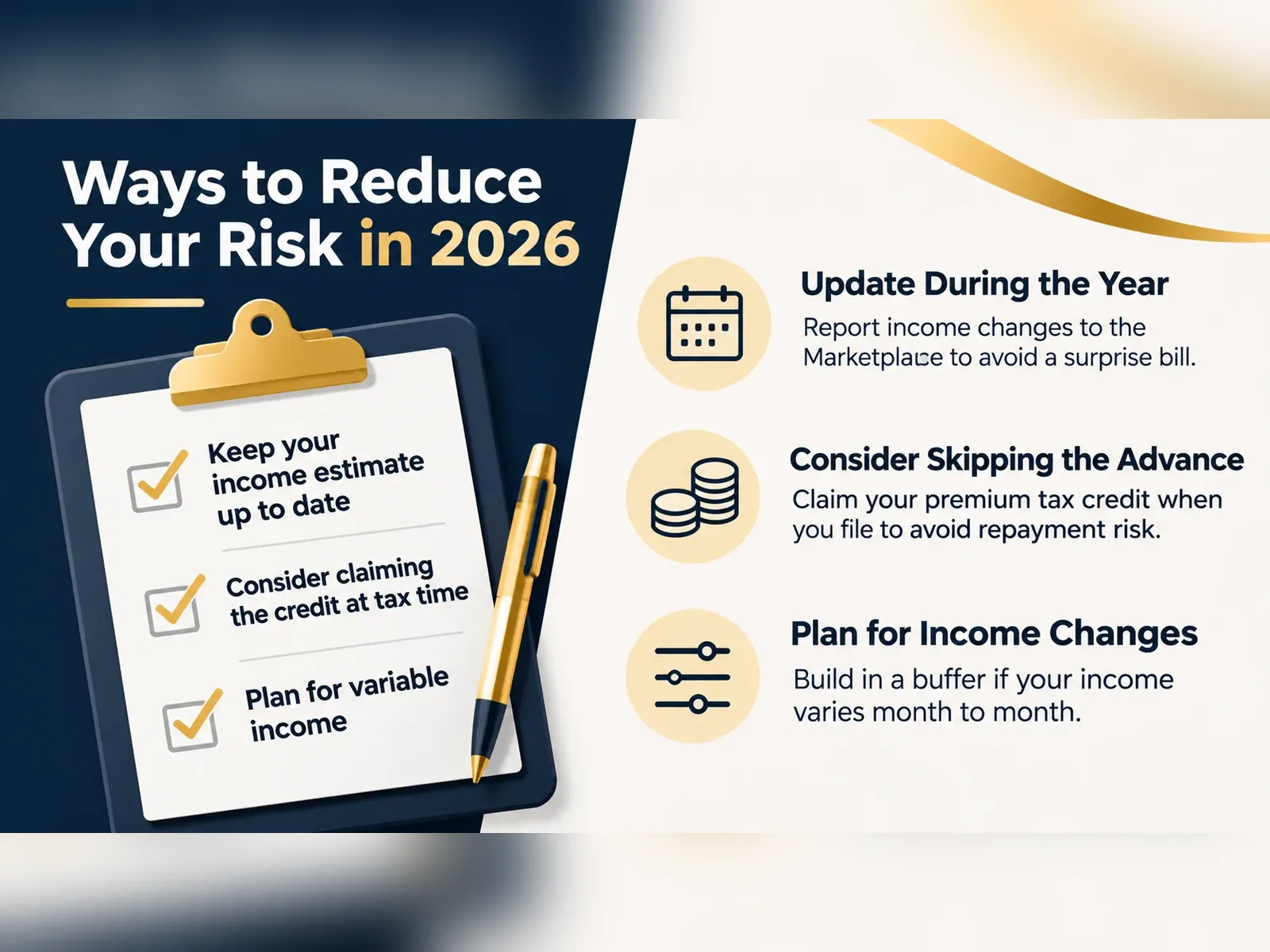
Report Income Changes to the Marketplace Right Away
Updating your Marketplace application the moment your income picture shifts adjusts your advance payments going forward. That shrinks the eventual reconciliation gap instead of letting a small misestimate compound for twelve straight months.
It’s the single most actionable step here, and it costs you a few minutes online.
Consider Claiming the Credit at Tax Time Instead of in Advance
Giving up the monthly discount in exchange for eliminating clawback risk entirely is a real tradeoff worth weighing. You can’t owe back a premium tax credit you never took in advance.
Whether that’s the right call depends on your cash flow, how variable your income actually is, and how much risk you’re comfortable carrying until April. Running your numbers through a plan comparison tool built for exactly this kind of decision can make the tradeoff a lot clearer than guessing.
What Hasn’t Changed About Your Coverage
Your plan isn’t disappearing. None of this touches your enrollment itself, your access to care, or your ability to keep the coverage you already have.
This is purely about the size of your subsidy and the math behind repaying it, not whether you have insurance at all.
Cost-sharing reductions are also untouched by any of it. If you qualify for CSRs, they still apply directly to your plan’s cost structure, and they’re never reconciled on your tax return the way the premium tax credit is. The two get confused constantly, and they shouldn’t be. Our frequently asked questions page breaks down the difference in plain terms if you want a clearer picture.

Work With The Benefits Boss to Build a Smarter Coverage Strategy
The rules just got a lot less forgiving. That makes a once-a-year, guess-and-hope enrollment riskier than it used to be.
We compare every major carrier with no brokerage fee to you, and we build your plan around your real income rather than a generic subsidy calculation. If you want a strategy that actually holds up when your year doesn’t go exactly as planned, get in touch with our team and let’s get you covered the right way.
Written by Marco
Licensed Coverage Advisor at The Benefits Boss